
This is an easy way to feel like you are really in Arctic Finland, not just passing through. I love the hands-on setup, you truly can walk out there with no snowshoe experience, and I also love the calm, early-morning feel of the forest during the Blue Moment. One thing to consider is that you are out in deep snow for a full 2-hour hike, so plan on cold weather and sensible pacing.
I also like how low-impact it feels while still working your body. The rhythm of the snowshoes, crunch-swish through powder, gives you a workout for core and balance without demanding technical skills. If you want a tour that is active but not punishing, this hits the sweet spot.
Finally, this is a guided nature experience, not a photo-only stroll. Your guide will steer you toward signs of wildlife and explain Lappish culture, so bring your curiosity and slow down enough to notice what is right in front of you.
Key Things I’d Prioritize Before You Go
- No-experience snowshoeing: Simple gear and instructions, if you can walk, you can snowshoe.
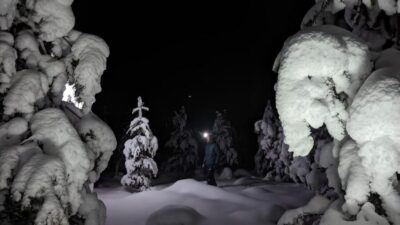
- tykkylumi, marshmallow trees: Rime ice makes pine and spruce look like giant white sculptures.
- Small-group pacing: Limited to 8 participants, so you get more personal guidance.
- Wildlife tracking in the morning: Early light is ideal for spotting subtle tracks like snow hare and Arctic fox.
- Honey tea warm-up: A seated break in a secluded forest spot with hot drink and homemade snacks.
Why Levi Morning Snowshoes Feel Different From a Typical Winter Tour
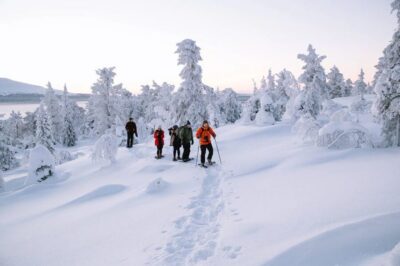
Levi in winter has two modes: the bustle around town and the silence once you leave the groomed paths behind. This experience leans hard into that second mode. You trade streetlights for a hushed taiga forest, where the only sounds you hear are your own steps, the snowshoe crunch, and the occasional creak of ice on branches.
What makes it special is that it is not just sightseeing. You move through the forest at a human pace, which makes details easier to notice, from rime-iced trees to tiny animal prints in the snow. The timing also helps. The tour runs in the Arctic morning light, the kind that turns the world cool blue and makes everything look sharper and quieter.
More Snowshoeing in Levi
- Levi: Pallas-Yllästunturi National Park Snowshoeing Tour
★ 4.8 · 112 reviews - Levi: Snowshoe Adventure in the Wilderness
★ 4.7 · 84 reviews - Levi: Scenic Levi Snowshoe Trip
★ 4.6 · 83 reviews
Meeting at Levi Info Center and Getting Ready Fast
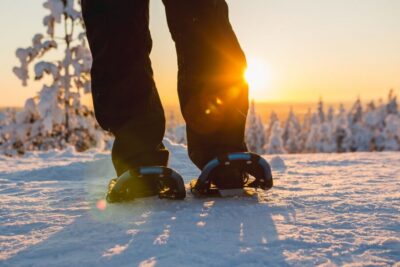
You meet your guide at the Levi Info Center, and the first part is all about getting you comfortable. You get a quick intro to the snowshoes and how they work, and the big promise here is real: you do not need prior experience. If you can walk normally, you can learn the basics quickly, because the snowshoes are designed for simple movement across snow.
This matters more than it sounds. When you start relaxed, the whole walk feels better. Instead of fighting your gear, you can spend your energy on balance and noticing the forest. That is how you end up enjoying the crunch-swish rhythm rather than thinking about your feet the whole time.
If you are traveling with kids who are not big walkers, this format can still work. One of the best signs of a good guided snowshoe trip is when people stop worrying about the “activity” and start enjoying the actual place.
Leaving Groomed Trails for Hushed Taiga Forest
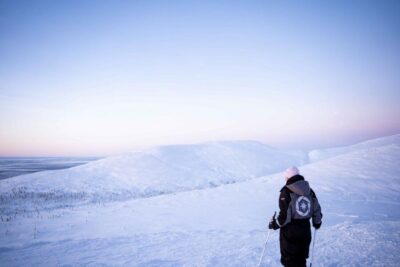
Right after the intro, you leave the groomed trails and the village area behind. Then you press into the taiga forest, where the snow gets deeper and the atmosphere gets quieter. This is where snowshoeing actually earns its keep. Deep snow that would be a problem on foot becomes passable, even peaceful, because the snowshoes spread your weight and help you move with less sinking.
The low-impact part is real, too. You are strengthening your core and balance while walking, but you are not doing steep technical terrain. Think of it as steady movement that teaches your body how to stay upright in soft snow.
And because you are going slowly, the guide can control the vibe. You are not rushing from view to view. Instead you are learning how to read the forest, the way the snow sits on branches, the way tracks show up, and the small signs of life that exist even when you cannot see animals.
Tykkylumi Marshmallow Trees: The Arctic Morning’s Star Attraction
One of the most memorable parts is the tykkylumi, the Finnish word for marshmallow trees. This is heavy rime ice and snow that clings to pine and spruce branches. The result is unreal, like someone coated the forest with a sculptor’s white material.
Walking under these ice-covered trees changes how the light feels. Everything becomes softer around the edges, and the trees look like frozen statues. It is the kind of detail that is easy to miss if you just stick to the main paths, which is why this guided approach is worth it.
You will likely see these “sculptures” while moving deeper into the forest, so it does not feel like a single stop in the middle. It feels like the whole walk is building to that moment, tree by tree, as the rime becomes more dramatic and the forest gets quieter.
A different kind of day from the same base:
- Levi: Snowmobile Northern Lights Hunting Trip
★ 4.6 · 610 reviews - Levi: Northern Lights Tour with Guaranteed Sightings
★ 4.6 · 542 reviews - Levi: Easy Snowmobile Safari into the Nature
★ 4.7 · 537 reviews - Levi: 5 Km Husky Sledding Ride in Levi
★ 4.8 · 494 reviews
The Blue Moment in Arctic Morning Light
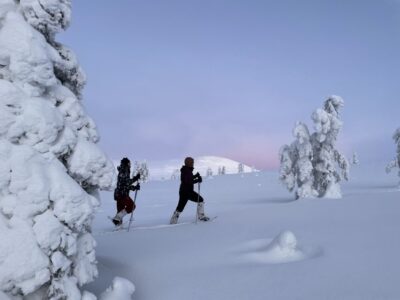
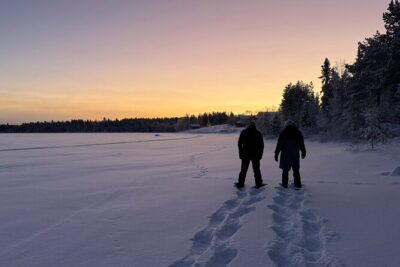
The tour highlights something you can feel right away, the Blue Moment. In practical terms, this means the walk happens during the early morning light when the sky and snow take on cool blue tones. The effect is not just aesthetic. It makes shadows sharper and textures stand out, so the powder, ice, and tree branches can look almost crisp.
This is also why the timing matters for wildlife tracking. In early morning conditions, subtle signs in the snow are easier to see, and movement patterns are easier to interpret. You are not guessing in the afternoon glare, you are observing in a steadier, calmer light.
Even if you are not chasing photos, the Blue Moment makes the forest feel cinematic in a real, lived-in way. You are not in a theme park. You are outside, hearing your own footsteps, watching nature do its quiet work.
Wildlife Tracking You Can Actually Use on the Walk
A good guide can tell you interesting facts, but a great guide gives you something you can look for. Here, the early morning is described as prime time for wildlife tracking, and the guide will point you toward signs that most people would never notice.
Two examples you will be paying attention for are:
- the tiny, perfect prints of the snow hare
- the distinct trail of the elusive Arctic fox
Important note: you are not guaranteed to see animals. That is not how it works in winter forests. What you can realistically do is learn what “reads” on the snow. Those track patterns give you a connection to the living Arctic, even when you only see traces.
This is also where Lappish culture and local knowledge come in. When your guide explains what those signs might mean and how wildlife uses the area, the walk turns into a nature lesson you can walk around inside.
If Mikus is your guide, expect a lot of friendly, practical explanations and a pace that helps you notice things without feeling rushed. The best part is that the information never feels like homework. It makes the snowy world feel readable.
The Midway Warm-Up: Honey Tea and Homemade Snacks in the Forest
Halfway through your snowshoe effort, you stop at a secluded spot for a warm break. This is not a quick coffee-and-go. Your guide prepares a warming moment of Finnish hospitality with a steaming cup of hot drinks sweetened with organic honey and a small traditional snack.
Why this matters: snowshoeing is active, but the cold air can still drain you. A seated break gives you a reset for your body and your attention. It also gives you time to look around without worrying about where your feet are going next.
The snack piece matters, too. You are not just warming up with something bland. A homemade style snack keeps the energy up so the second half of the walk feels good rather than heavy.
This stop is also a nice cultural moment. It is simple and grounded, and it makes the walk feel human, not just survival training in winter.
How Hard Is It, Really? Fitness, Age, and Comfort
This tour is described as suitable for all fitness levels and ages 7+, and it is also built to be an easy learn for beginners. You are outdoors, walking in snow, so you should expect effort. But it is not a climb, and it is not technical.
The guide keeps the movement accessible, with the option to go at a comfortable pace. One theme you will likely feel in the experience is that it works for both sporty people who can handle deeper snow and more relaxed walkers who want to follow the treeline and the safe path through it.
That said, there are clear limits. It is not suitable for children under 7, and it is not suitable for people over 70. If you are in that range, it is worth choosing a different format that matches your mobility and stamina.
Also, do not over-plan your schedule. Although the duration is listed as 2 hours, the walk can feel flexible depending on group energy and how much time the guide spends spotting details. Build in buffer time, especially if you have other activities later the same morning.
Price and Value: Is $105 Worth It?
At $105 per person for a 2-hour guided snowshoe experience, you are paying for more than “being outside.” You are paying for:
- snowshoe rental
- guidance throughout
- a hot drink sweetened with organic honey
- healthy homemade snacks
- a small-group experience limited to 8 participants
When you compare that to renting gear alone, then figuring out a route and staying safe in deep snow, the value becomes clearer. You also get expert help reading the forest, which is hard to replicate on your own, especially when you want to understand things like tykkylumi, wildlife tracks, and the local culture behind the scenery.
The small group size adds value in a very practical way. With fewer people, the guide can adjust pace and spend time explaining without leaving anyone behind. That is exactly why families and mixed groups can enjoy it, even when walking comfort varies.
Who Should Book This Morning Wake-Up Snowshoe Tour
This is a great fit if you want Arctic nature with guidance, and you prefer a calm morning pace over a high-adrenaline outing. It is also a good match if you are traveling with:
- first-time snowshoe users who want instruction but hate complicated gear
- families with older kids who can handle a 2-hour hike in snow
- anyone who likes learning, especially when the learning is tied to what you see right now
If your travel style is mostly quick photo stops, you might find this less satisfying. This tour rewards attention, slow observation, and patience for subtle signs like tracks.
Should You Book It or Skip It in Levi?
I would book it if you want a morning that feels authentic, active without being stressful, and full of real Arctic details. The mix of beginner-friendly snowshoeing, the magic of tykkylumi, early-morning wildlife tracking cues, and a warm honey drink in the forest is a strong package for the time.
Skip it only if deep snow hiking is a hard no for you, or if the age limits do not work. Also skip if you hate guided experiences and want to wander alone, because the value here is the way the guide helps you see more than you would on your own.
If you want your Levi morning to be peaceful, instructional, and genuinely memorable, this snowshoe walk is one of the best bets.
FAQ
How long is the snowshoe tour in Levi?
The duration is 2 hours, including the snowshoeing hike and the warm-up break.
Do I need prior experience to go snowshoeing?
No. The snowshoes are simple to use, and the activity requires absolutely no prior experience.
Where do I meet the guide?
The guide will find you at the Levi Info Center.
What is included in the price?
Guidance is included, along with snowshoes rental. You also get tea with organic honey and healthy homemade snacks.
Is there a warm-up during the tour?
Yes. Midway through the hike, you stop in a secluded forest spot for hot drinks sweetened with organic honey and a small traditional snack.
How large are the groups?
The tour is a small group, limited to 8 participants.
What age is this tour suitable for?
It is suitable for ages 7+ and all fitness levels. It is not suitable for children under 7.
Is it suitable for older adults?
It is not suitable for people over 70.
What languages will the guide speak?
The live tour guide speaks English, Latvian, and Lettish.
Just reviewed around Levi
- Levi: Aurora Borealis Tracking & Photography Tour By Car★ 5.0 · 3 reviews
- Snowshoeing in Levi★ 3.5 · 3 reviews
- Levi: Snowmobile and Ice Fishing Safari with Campfire Snacks★ 5.0 · 3 reviews
- Levi: Magic Winter Trail 5 km Self-Drive Huskies Small Group★ 5.0 · 3 reviews
- Reindeer Husbandry with Snowmobile Sleigh Ride and Cabin Lunch★ 5.0 · 3 reviews
- A fun 3-km Husky Safari from Levi Including a Husky Sled Ride★ 5.0 · 3 reviews
- Levi: Aurora Hunting by Car★ 5.0 · 3 reviews
- Snowmobile Safari into the Nature in Levi★ 3.5 · 3 reviews
Snowshoeing, compared.
Pallas-Yllästunturi National Park Snowshoeing Tour
Read our review →
Arctic Reindeer Farm Experience with Snowshoeing in the Wild
Read our review →Browse the lists this tour appears in